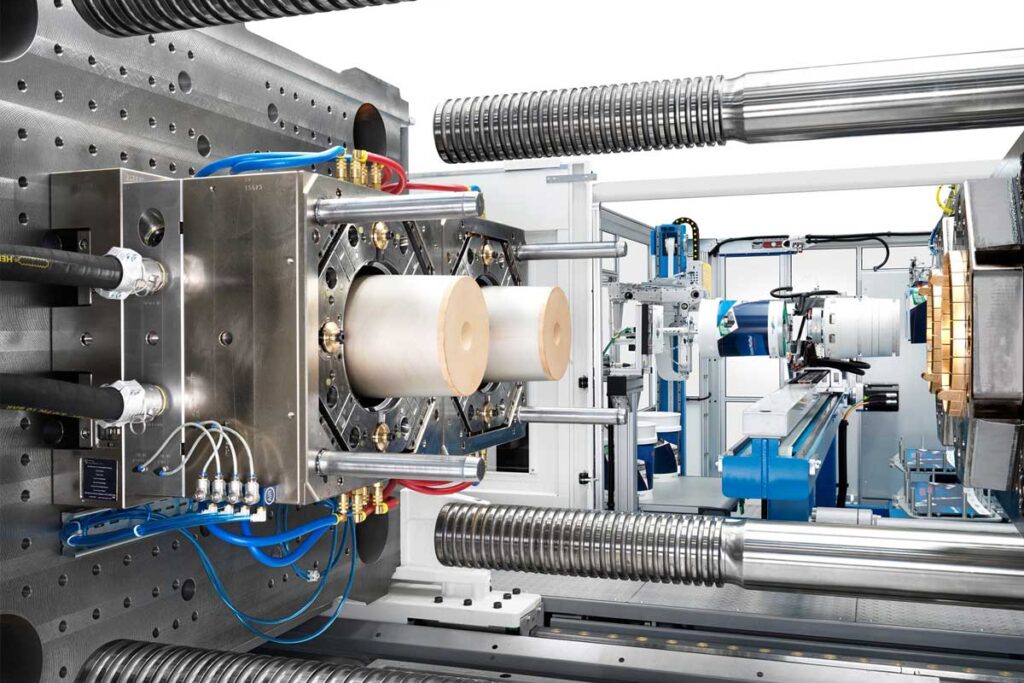
Choosing the right partner for the production of diary containers requires more than selecting the injection moulding machine, IML Robot and moulds.
Packaging influences product quality, shelf appeal, and operational efficiency, which means your partner must understand the full journey from raw material to filled product. This is especially important in injection moulding, where precision and consistency directly affect performance on high speed dairy lines.
A strong partner begins by understanding the complexity of your supply chain. This includes consumer preferences and use habits, the logistical supply chain requirements of yoghurt containers, and the behaviour of your product throughout distribution. Technology such as the KraussMaffei GX Series supports this reliability by delivering stable cycle times, excellent repeatability, and reduced scrap.
Your partner must also understand your customers’ expectations and your filling process. Yoghurt packaging must be easy to open, durable, leak proof, and visually appealing. At the same time, your filling line requires containers that maintain dimensional accuracy, withstand sealing conditions, and run smoothly at speed. This is why correct IMM specification is essential, ensuring the machine matches the mould, cycle time, and thin wall requirements.
Material choice plays a major role. The right material selection determines barrier performance, stacking strength, and recyclability. Equally important is correct mould design, which influences part quality, cooling efficiency, and long term production stability.
IML technology enhances premium yoghurt packaging. IML robot integration ensures accurate label placement, fast cycles, and high quality decoration. Plastrading strengthens this by integrating automation and ancillary equipment, including robotics, cooling, conveying, and quality inspection, creating a complete production cell.
Ultimately, the right partner understands product design in relation to market expectations and what your end product must achieve. With the correct combination of expertise, technology, and integrated automation, you can produce yoghurt containers that protect your product, support your brand, and deliver reliable performance.
The most high performance environment requires high performance machinery.
FAQ
1. What should I look for in a partner for dairy container manufacturing?
Look for a partner who understands your full production ecosystem, including injection moulding, material behaviour, mould design, automation, and filling line requirements. They should support you from concept to final container performance.
2. Why do consumer preferences matter when designing dairy packaging?
Consumer preferences and use habits influence opening behaviour, durability expectations, recyclability choices, and shelf appeal. Packaging must match how customers actually use the product.
3. How do I choose the right material for dairy containers?
The right material choice affects barrier performance, stacking strength, thin wall capability, and recyclability. PP is common, but the final choice depends on your filling process and shelf life requirements.
4. What logistical supply chain factors affect dairy packaging?
Your partner must understand logistical supply chain requirements such as transport loads, palletisation, storage conditions, and distribution risks. Poor planning here leads to deformation, cracking, or seal failures.
5. Why is mould design so important for dairy cups and tubs?
Correct mould design determines cooling efficiency, cycle time, part accuracy, and long term production stability. Thin wall dairy containers require highly optimised moulds to run reliably at speed.
6. What is IML and why is it used for dairy packaging?
IML robot integration places labels directly into the mould during production, creating premium, fully decorated containers with excellent recyclability and consistent label placement.
7. How do I know if my injection moulding machine is correctly specified?
Correct IMM specification ensures the machine has the right clamp force, injection speed, and energy profile for thin wall dairy containers. The KraussMaffei GX Series is designed for this exact application.
8. What role does automation play in dairy container production?
Automation improves cycle time, label placement, part handling, cooling, and quality inspection. A partner like Plastrading integrates robotics, IML systems, conveying, and ancillaries into a complete production cell.
9. How do filling and sealing requirements influence dairy container design?
Filling and sealing requirements determine wall thickness, rim geometry, material choice, and dimensional accuracy. Containers must run smoothly on high speed lines without deformation.
10. Why is the KraussMaffei GX Series recommended for dairy packaging?
The GX Series offers fast cycles, excellent repeatability, and thin wall performance ideal for dairy applications. When combined with integrated automation, it delivers stable, high quality container production.